
Trading financial markets usually stops on Friday evening. Financial exchanges close their doors until Monday morning. However, modern binary options platforms like Quotex offer continuous access. You can trade Over-The-Counter (OTC) currency pairs all weekend long. Applying a proven Quotex OTC market trading strategy helps you navigate these charts with confidence.
Weekend trading opens up round-the-clock profit opportunities. It allows busy individuals to trade on Saturday and Sunday. Yet, OTC charts do not move like live global markets. Understanding how these synthetic price feeds work is vital. This deep dive explores technical setups, risk strategies, and technical methods for trading OTC pairs safely on Quotex.
What Is the Quotex OTC Market and How Does It Work?
OTC stands for Over-The-Counter. In regular market hours, trades execute on centralized global exchanges. When traditional institutions close, brokers use internal market mechanisms. Quotex OTC pairs represent algorithmically generated price feeds. They blend historical asset behavior, mathematical modeling, and platform liquidity.
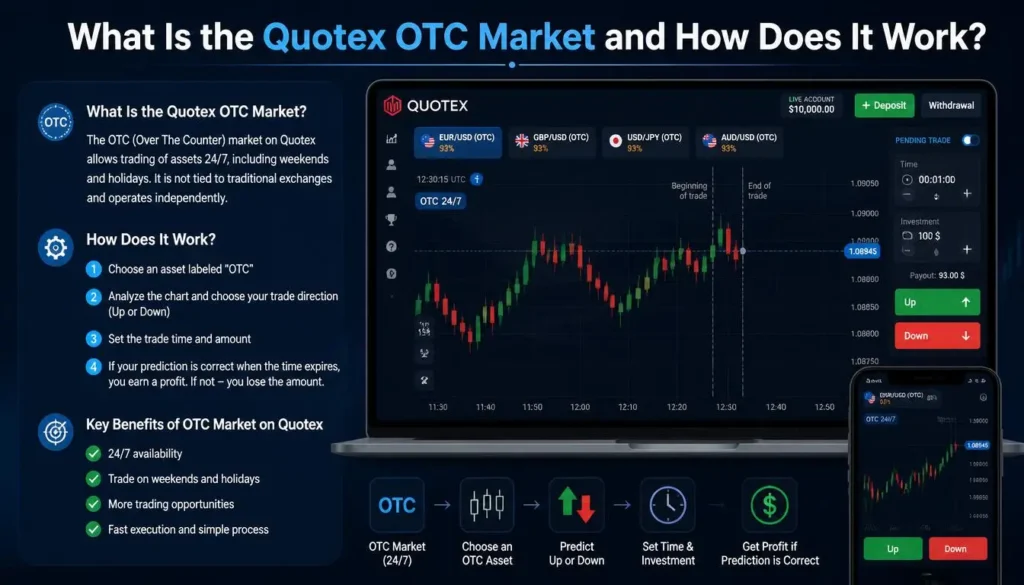
Key Differences: Live Markets vs. OTC Pairs
Live assets react directly to fundamental factors. Economic news, interest rate updates, and geopolitical shifts drive their movement. In contrast, OTC charts ignore external global news events.
- Price Generation: Live markets rely on interbank order books. OTC assets follow broker algorithms and historical data trends.
- Payout Ratios: Standard weekend assets often offer low yields. Quotex OTC currency pairs frequently keep payout rates above 85% to 92%.
- Trend Behavior: OTC charts usually display long, clean directional waves. However, they can undergo sudden algorithmic shifts.
How to Set Up Your Chart for a Quotex OTC Market Trading Strategy
Proper chart configuration builds a strong technical foundation. Trading without clean visuals leads to rushed decisions.
- Select High-Yield Pairs: Log into Quotex on the weekend. Look for pairs labeled with the “OTC” suffix, such as
EUR/USD (OTC)orGBP/JPY (OTC). Select pairs with payouts over 80%. - Switch to Japanese Candlesticks: Select Japanese Candlesticks as your chart type. Avoid line charts because they hide candle wicks and price rejection signals.
- Choose the Timeframe: Set your candle timeframe to 1 minute or 5 minutes. Short timeframes work best for quick binary options expiry cycles.
- Apply Essential Indicators: Keep your screen clear of clutter. Apply Exponential Moving Averages (9 EMA and 21 EMA), the Relative Strength Index (RSI set to 14), and Bollinger Bands (20 period, 2 standard deviations).
Winning Setups for Your Quotex OTC Market Trading Strategy
Algorithmic assets follow predictable technical patterns. Below are three highly reliable execution setups tailored for weekend OTC charts.
1. The Trend-Following EMA Crossover Setup
OTC algorithms often build strong momentum once a direction starts. Following the prevailing trend provides a reliable edge.
- Indicator Setup: 9 EMA (Fast, Green Line) and 21 EMA (Slow, Red Line).
- Call Option Entry: Wait for the 9 EMA to cross above the 21 EMA. Ensure the price candles trade above both moving averages. Enter a 2-minute to 3-minute CALL trade on the next candle opening.
- Put Option Entry: Wait for the 9 EMA to cross below the 21 EMA. Confirm candles are closing below both EMA lines. Enter a 2-minute to 3-minute PUT trade.
| Parameter | CALL (BUY) Setup | PUT (SELL) Setup |
| EMA Line Action | 9 EMA crosses above 21 EMA | 9 EMA crosses below 21 EMA |
| Candle Position | Above both EMAs | Below both EMAs |
| RSI Reading | Above 50 moving upward | Below 50 moving downward |
| Trade Duration | 2 to 3 Minutes | 2 to 3 Minutes |
2. Support and Resistance Reversal Setup
OTC charts respect key historical price levels consistently. Support and resistance lines act as primary turning points.
- Mark Key Zones: Identify horizontal levels where price turned at least twice earlier in the session.
- Wait for Rejection Wicks: Let the current candle test the level. Look for long upper or lower wicks, which indicate price rejection.
- RSI Confirmation: Ensure the RSI indicator shows overbought conditions (above 70) for PUT trades, or oversold conditions (below 30) for CALL trades.
- Execution: Enter a 1-minute to 2-minute counter-trend trade as soon as the rejection candle completes.
3. Bollinger Band Breakout Setup
Synthetic price feeds often experience periods of low volatility followed by rapid expansions.
- Identify the Squeeze: Watch for Bollinger Bands contracting into a narrow horizontal channel.
- Spot the Breakout: Wait for a strong full-bodied candle to close outside the upper or lower band.
- Confirm with Volume: A large candle closing beyond the bands confirms algorithmic expansion.
- Trade Entry: Place a 1-minute option in the direction of the breakout.
Essential Risk Rules for Your Quotex OTC Market Trading Strategy
Without solid risk management, even high-win-rate technical setups can fail. Protecting trading capital requires strict discipline.

- Limit Risk Per Trade: Never invest more than 1% to 2% of total account balance on a single trade.
- Set Daily Stop-Loss Rules: Stop trading immediately after losing 3 consecutive trades. Step away to prevent emotional revenge trading.
- Establish Target Goals: Set a realistic daily profit target of 5% to 10%. Lock in profits and log off once reached.
- Avoid Martingale Escalation: Doubling trade amounts after losses risks fast balance depletion. Stick to fixed dollar amounts.
Common Mistakes When Executing a Quotex OTC Market Trading Strategy
Trading synthetic assets differs from live sessions. Avoiding these common traps helps protect account capital:
- Trading During Sudden Spikes: Avoid trading when price action displays unnatural, erratic wick jumps.
- Ignoring Demo Practice: Always test new indicator combinations on a demo account before risking live capital.
- Over-Trading: Executing dozens of positions within short spans increases exposure to algorithmic shifts.
- Chasing Lost Positions: Market algorithms do not care about individual losses. Accept minor setbacks calmly.
Frequently Asked Questions (FAQs)
Conclusion
Executing a structured Quotex OTC market trading strategy during weekends provides great flexibility and continuous profit opportunities. Success in this algorithmic environment requires technical analysis, quick execution, and firm emotional control. By using EMA crossovers, support-resistance rejections, and strict risk parameters, traders can build a stable edge on weekends. Master your setup on a demo account, manage risk per trade, and approach OTC markets with structured discipline.