
Trend following is one of the simplest ways to trade with the market instead of against it. Many traders search for the perfect indicator combo, yet most of them overlook the free tools already sitting inside their Quotex platform. This guide breaks down the three best free indicators for trend following on Quotex, plus how to combine them for stronger signals.
You don’t need paid software or a premium subscription to spot strong trends. Quotex offers a full indicator library at no cost, and a few of these tools consistently outperform the rest for trend traders. Let’s explore them one by one.
Why Trend Following Works on Quotex
Trend following is built on a simple idea. Prices tend to keep moving in one direction once a trend is established. A trader who follows this direction has a statistical edge over one who trades against it.
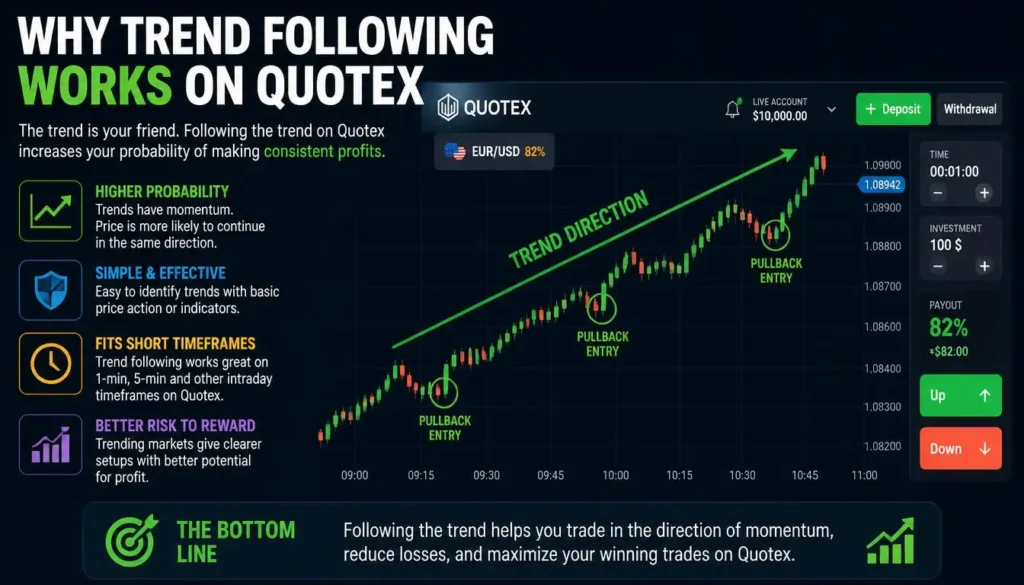
This strategy suits both new and experienced traders. It removes guesswork and replaces it with a rules-based approach. Below, three indicators are explained in detail, along with how they fit into a complete trend following system.
1. Moving Average (MA) — The Foundation of Trend Trading
The Moving Average is the most trusted indicator among trend traders worldwide. It smooths out price fluctuations and reveals the underlying direction of the market.
How the Moving Average Works
A Moving Average calculates the average price over a chosen period and plots it as a single line. When price stays above this line, the trend is considered bullish. When price stays below it, the trend is considered bearish.
Two variations are commonly used on Quotex. The Simple Moving Average (SMA) reacts slowly and filters out noise. The Exponential Moving Average (EMA) reacts faster and weighs recent prices more heavily.
Best Settings for Quotex Trend Trading
A 20-period EMA works well for short-term trades. A 50-period EMA suits swing-style entries. Many traders combine both. When the 20 EMA crosses above the 50 EMA, it often signals a fresh uptrend. The opposite crossover often signals a downtrend.
Why Traders Prefer It
This indicator is simple, visual, and beginner-friendly. It is also completely free on Quotex, and it forms the base layer for almost every trend strategy used today.
2. MACD (Moving Average Convergence Divergence)
The MACD indicator adds momentum analysis to trend detection. It is built from two moving averages and a histogram, making it more advanced than a single MA line.
How MACD Confirms a Trend
The MACD line and signal line move above and below a zero line. When the MACD line crosses above the signal line, momentum is shifting upward. When it crosses below, momentum is shifting downward.
The histogram bars shrink or grow depending on strength. Taller bars usually mean the current trend is gaining power. Shrinking bars often warn that a reversal could be near.
Using MACD Alongside Moving Averages
Many traders wait for the Moving Average to confirm direction first. Then they check MACD for a matching crossover. This double confirmation filters out many false signals and improves entry accuracy.
Why It’s a Top Choice
MACD works across nearly every timeframe on Quotex. It is free, widely tested, and gives a momentum layer that a simple moving average cannot provide on its own.
3. ADX (Average Directional Index)
The ADX indicator answers a different question than the first two. Instead of showing direction, it shows trend strength. This makes it a powerful filter for avoiding weak, choppy markets.
How ADX Measures Strength
The ADX line moves between 0 and 100. A reading below 20 usually signals a weak or sideways market. A reading above 25 often signals a strong, tradable trend. Readings above 40 suggest a very strong move.
Combining ADX with Trend Direction Tools
ADX alone does not show whether the trend is bullish or bearish. Pairing it with the +DI and -DI lines, which are built into the same indicator, solves this. When +DI is above -DI and ADX is rising, the uptrend is considered strong and reliable.
Why Traders Rely on ADX
ADX helps traders avoid entering trades during flat, low-volatility conditions. It works as a final filter, confirming that a trend is strong enough to trade before an entry is placed.
How to Combine These Three Indicators
A complete trend following setup on Quotex often uses all three tools together. The Moving Average defines the basic direction. MACD confirms momentum in that same direction. ADX confirms the trend has enough strength to continue.
This layered approach reduces false signals significantly. It also builds patience into a trading routine, since trades are only taken when all three indicators agree.
Extra Tips for Faster, Safer Trend Trading
Always check higher timeframes before entering on a lower one. A trend on the 15-minute chart carries more weight when the 1-hour chart agrees with it.
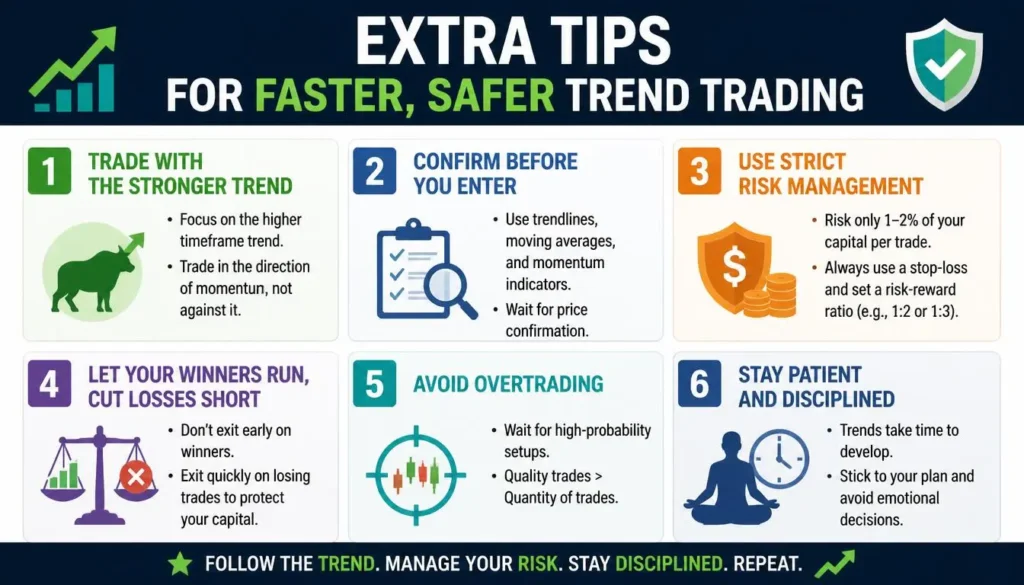
Avoid trading during major news releases, since indicators often lag behind sudden price spikes. Practicing on a demo account first also helps traders understand how these three indicators behave in real market conditions before risking real funds.
Risk Disclaimer
Trading involves substantial risk, and no indicator guarantees profit. Past performance does not predict future results. This article is for educational purposes only and should not be considered financial advice. Always trade with capital you can afford to lose, and consider practicing on a demo account first.
Frequently Asked Questions (FAQs)
Conclusion
Trend following does not require expensive tools or complicated systems. The Moving Average, MACD, and ADX together form a free, reliable, and beginner-friendly toolkit available right inside Quotex. Used together, they help traders spot genuine trends, confirm momentum, and avoid weak market conditions. As with any strategy, patience, practice, and proper risk management remain the real keys to long-term success.