
Scalping on Quotex demands speed, discipline, and a tool that reacts fast to price swings. Bollinger Bands do exactly that. They wrap price action in a dynamic envelope, showing you when the market is calm and when it’s about to explode.
This guide breaks down a practical Bollinger Bands scalping strategy built for Quotex. You’ll learn the setup, entry and exit rules, risk management, and common mistakes to avoid. Let’s get into it.
What Are Bollinger Bands and Why Scalpers Use Them
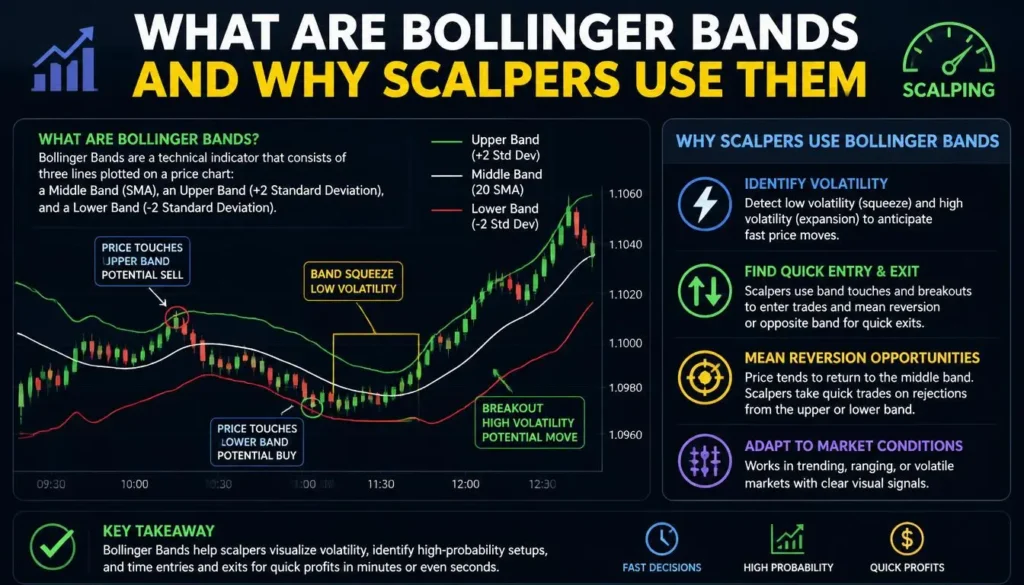
Bollinger Bands consist of three lines plotted on your chart. The middle line is a moving average, usually set to 20 periods. The upper and lower bands sit two standard deviations away from that average.
When volatility rises, the bands widen. When the market goes quiet, they squeeze together. This behavior gives scalpers a visual map of momentum shifts, which is exactly what’s needed for short, fast trades.
On Quotex, price often moves in quick bursts. Bollinger Bands help traders catch these bursts early, rather than reacting after the move has already happened. That timing edge is the whole point of scalping.
How the Bands Are Calculated
The middle band is a simple moving average (SMA), typically 20 candles. The upper band adds two standard deviations to that average, while the lower band subtracts two standard deviations.
Most Quotex traders don’t need to calculate this manually. The platform’s charting tool plots Bollinger Bands automatically once selected from the indicator list.
Setting Up Bollinger Bands on Quotex
Getting your chart ready takes less than a minute. Here’s the setup most scalpers rely on.
- Open your Quotex chart and click the indicator icon.
- Search for “Bollinger Bands” and add it to your chart.
- Set the period to 20 and the deviation to 2 for standard scalping conditions.
- Switch your timeframe to 1-minute or 5-minute candles for quick entries.
- Combine it with the RSI or Stochastic indicator for extra confirmation.
This combination gives a clean, uncluttered chart. It’s fast to read, which matters a lot when trades last only a few minutes.
Best Timeframes for Scalping with Bollinger Bands
Shorter timeframes suit scalping better since trades close quickly. The 1-minute and 5-minute charts are the most common choices among Quotex scalpers.
However, the 1-minute chart produces more noise and false signals. Traders who want fewer but cleaner setups often prefer the 5-minute chart instead.
The Core Bollinger Bands Scalping Strategy
This strategy centers on one simple idea: price tends to bounce off the bands during ranging markets, and it tends to break through them during trending markets. Knowing which condition you’re in changes everything.
Strategy 1: The Band Bounce (Range Trading)
When the market isn’t trending, price often touches the upper or lower band and reverses back toward the middle line. This is the classic scalping setup.
Entry rules:
- Wait for price to touch or slightly pierce the lower band.
- Look for a reversal candle, such as a hammer or bullish engulfing pattern.
- Enter a buy trade once the reversal candle closes.
For a sell setup, simply reverse the logic. Price touches the upper band, a bearish reversal candle forms, and a sell trade is placed once that candle closes.
Confirmation tip: Add RSI to your chart. If RSI shows oversold conditions (below 30) at the lower band, or overbought conditions (above 70) at the upper band, your signal becomes stronger.
Strategy 2: The Squeeze Breakout
Sometimes the bands tighten into a narrow squeeze. This usually signals that a big move is coming, though the direction isn’t clear yet.
Entry rules:
- Identify a tight squeeze where the bands are close together.
- Wait for a strong candle to break outside either band.
- Enter in the direction of that breakout candle.
This setup works especially well before major news releases or during the London-New York session overlap, when volatility tends to pick up.
Strategy 3: The Middle Band Trend Trade
During strong trends, price tends to ride along the upper or lower band rather than reversing. In this case, the middle band (the moving average) acts as dynamic support or resistance.
Entry rules:
- Confirm the market is trending using higher highs or lower lows.
- Wait for a pullback toward the middle band.
- Enter in the direction of the trend once price bounces off the middle line.
This strategy suits traders who prefer riding momentum instead of catching reversals.
Risk Management Rules for Bollinger Bands Scalping
No strategy works without solid risk control. Scalping involves frequent trades, so small mistakes add up fast if left unchecked.
- Risk no more than 1-2% of your account balance per trade.
- Set a fixed stop-loss based on recent swing highs or lows.
- Avoid trading during major news events unless you’re specifically trading the breakout.
- Stop trading after three consecutive losses to avoid emotional decisions.
- Track your win rate weekly and adjust your approach accordingly.
Consistency matters more than any single winning trade. A disciplined scalper survives losing streaks that wipe out impulsive traders.
Combining Bollinger Bands with Other Indicators
Bollinger Bands work well alone, but pairing them with a second indicator filters out weak signals. Here are combinations that many Quotex traders find effective.
Bollinger Bands + RSI
RSI confirms whether price is genuinely overbought or oversold. This pairing reduces false reversal signals near the bands.
Bollinger Bands + MACD
MACD helps confirm trend direction before taking a middle-band trend trade. If MACD agrees with the trend, the trade setup carries more weight.
Bollinger Bands + Support and Resistance
Marking key support and resistance zones adds another layer of confirmation. A band touch that lines up with a strong support zone tends to produce a stronger bounce.
Common Mistakes Scalpers Make with Bollinger Bands
Even experienced traders fall into these traps. Avoiding them can noticeably improve your results.
- Trading every touch of the band. Not every touch leads to a reversal, especially in strong trends.
- Ignoring the broader trend. A range strategy applied during a strong trend often leads to losses.
- Skipping confirmation signals. Entering purely because price touched a band, without a candle pattern or RSI confirmation, increases risk.
- Overtrading after a loss. Chasing losses tends to compound them rather than recover them.
- Using the wrong timeframe. Ultra-short timeframes generate more noise, which can mislead less experienced traders.
Other Strategies to Boost Your Scalping Results
Bollinger Bands work best as part of a broader toolkit. Consider layering in these approaches over time.
- Price action scalping: Reading candlestick patterns without relying solely on indicators.
- Support and resistance scalping: Trading bounces and breaks at well-tested price levels.
- Trend-following scalping: Using moving averages to stay aligned with the dominant direction.
- News-based scalping: Capturing volatility spikes around scheduled economic releases.
Testing these strategies on a Quotex demo account first is a smart move. It lets you build confidence without risking real capital.
Conclusion
Bollinger Bands give Quotex scalpers a clear, visual way to read volatility and momentum. Whether you’re bouncing off the bands in a ranging market, catching a squeeze breakout, or riding a trend along the middle line, the key lies in patience and confirmation.
Combine this strategy with strict risk management, and avoid the common mistakes outlined above. Over time, this disciplined approach tends to outperform impulsive, indicator-free trading. Practice on a demo account, refine your entries, and let consistency do the heavy lifting.