
Trading digital options requires fast timing and reliable technical signals. Every market move can mean the difference between profit and loss. Many traders struggle because they rely on random guesses or delayed trading alerts. Learning how to find high-accuracy signals for Quotex trading requires a structured technical approach.
High-accuracy Quotex trading signals depend on technical analysis, chart patterns, and market indicators. Combining multiple strategy filters helps you spot strong entry points easily.
This comprehensive guide breaks down step-by-step methods to generate high-accuracy Quotex signals. You will learn to build personalized strategies, analyze candle patterns, and avoid false market traps.
What Are High-Accuracy Signals for Quotex Trading?
Quotex trading signals are actionable alerts that tell you when to enter a trade. These alerts specify the asset, direction (Up/Call or Down/Put), and expiry time.
Understanding how to find high-accuracy signals for Quotex trading starts by looking at signal sources. Automated algorithms process mathematical formulas to generate instant technical signals. Professional analysts perform manual chart analysis to identify key price setups.
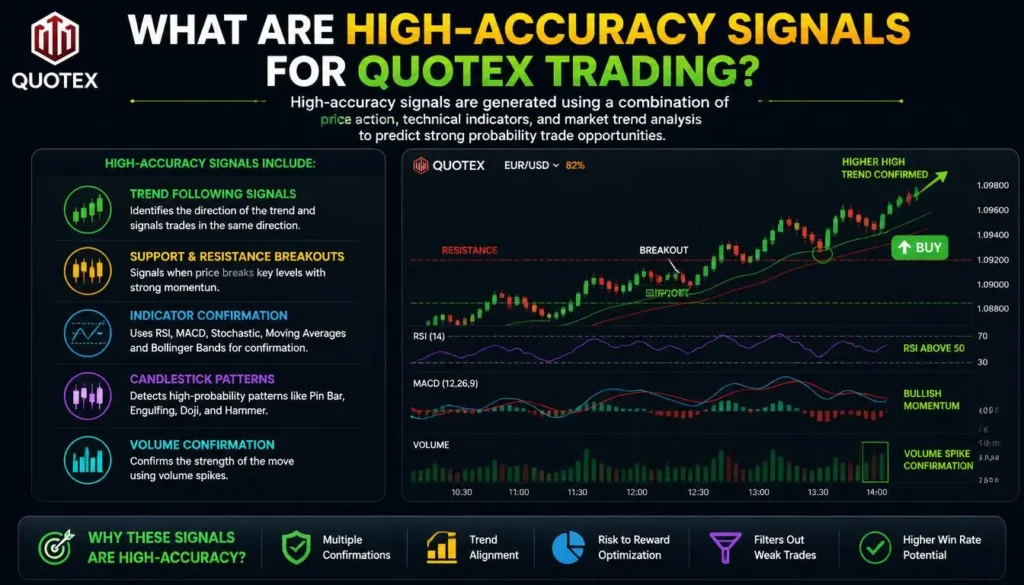
High-accuracy signals reduce guesswork by highlighting high-probability market opportunities. However, blind reliance on external signals without personal confirmation often leads to losses. Mastering technical confirmation tools ensures consistent trading performance.
Key Types of Signals in Quotex Trading
Understanding signal source types helps you choose the right approach for your style.
1. Technical Indicator Signals
These signals form when technical tools give matching market readings. For instance, an RSI oversold reading combined with a Moving Average crossover generates a strong buying signal.
2. Price Action Signals
Price action signals rely entirely on raw price movement. Traders spot key candlestick patterns, trendlines, and support or resistance levels to predict future price direction.
3. Automated & Algorithmic Signals
Trading bots and scripts send real-time alerts when market criteria align. These tools process complex data fast, but they struggle during high-impact news releases.
Best Technical Indicators for High-Accuracy Quotex Signals
Combining 2 to 3 complementary indicators creates a reliable confirmation system that filters out market noise.
How to Find High-Accuracy Signals for Quotex Trading (Step-by-Step)
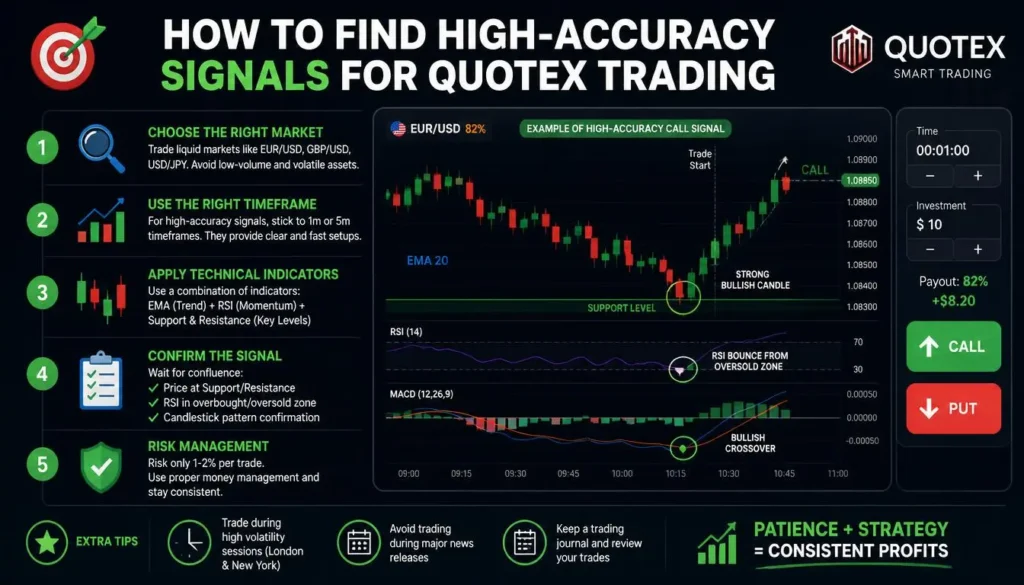
Building your own trading strategy gives you full control over every trade entry. Follow this tested multi-step system when learning how to find high-accuracy signals for Quotex trading.
Step 1: Identify the Main Trend
Never trade against the dominant market direction. Apply a 200-period Exponential Moving Average (EMA) to your chart. If price trades above the 200 EMA, look only for Call (Up) signals. If price stays below, focus strictly on Put (Down) signals.
Step 2: Mark Key Support and Resistance Zones
Switch to a 5-minute chart timeframe. Draw horizontal lines across levels where prices bounced repeatedly. Strong support zones act as springboards for Call trades, while resistance levels yield solid Put trades.
Step 3: Add Oscillator Confirmation
Use the Relative Strength Index (RSI) set to a 14-period default. Wait for the RSI line to drop below 30 near support or rise above 70 near resistance. This confirms extreme price exhaustion.
Step 4: Confirm with Candlestick Rejection Patterns
Wait for a price action rejection candle at your level. Look for long-wick Pin Bars or Engulfing candles closing in your expected direction. Enter the trade right as the signal candle closes.
How to Filter Out Fake Signals in Quotex Trading
False breakouts cause most binary option losses. Learning to identify weak setups protects your capital.
Avoid Trading During Economic News
High-impact economic news causes erratic price spikes that ignore technical indicators. Avoid opening trades 15 minutes before and after major news releases on economic calendars.
Skip Low Volatility Markets
Flat, side-ways moving markets compress price action into tight ranges. Indicators generate frequent false crossovers in flat markets. Trade assets displaying clear, defined momentum instead.
Match Chart Timeframes with Expiry Times
Using an improper expiry length ruins accurate signal setups. Match your expiration time to your chart timeframe to give trades room to develop.
Risk Management for Quotex Signal Traders
Even high-accuracy signals encounter unexpected loss streaks. Proper money management keeps you profitable over time.
- Fixed Percentage Rule: Risk only 1% to 2% of your account balance per trade.
- Avoid Martingale Escalation: Doubling trade sizes after losses can drain accounts quickly during bad market conditions.
- Set Daily Stop-Loss Limits: Stop trading immediately if you hit a 5% daily loss limit to protect your capital.
- Test Strategies on Demo First: Always validate new signal rules on a demo account before risking real funds.
Frequently Asked Questions (FAQs)
Conclusion
Mastering how to find high-accuracy signals for Quotex trading requires combining technical indicators, price action setups, and strict market filters. Relying solely on automated alerts or unverified channels rarely brings sustained success. By mastering trend confirmation, marking key support levels, and tracking candlestick triggers, you can generate reliable trading entries consistently. Always prioritize risk management and refine your execution on a demo account before trading live.